

I hear one question in almost every AI workshop or training I run: ‘Which tools should we be using?’
It’s a fair question. It’s also the wrong place to start.
The tools will change. They already change month to month. What doesn’t change is the responsibility we carry for outcomes our communication has — whether people can trust it, whether they can make informed choices because of it, and whether the organisations we advise make better decisions as a result. AI doesn’t remove that responsibility. It multiplies it.
That’s why the Centre for Strategic Communication Excellence has launched the CSCE Responsible AI Leadership Framework for Communication. It replaces the responsible AI principles we published in 2024, and it reframes responsible AI as what I believe it truly is: a leadership challenge for our profession.
Adoption is settled. Leadership isn’t.
Let’s start with where we are. Reimagining Tomorrow 2026, the latest global study from the Global Alliance, produced with the CSCE and Reputation Lighthouse, drew 536 responses from communication professionals across six regions. The headline? 95.9% of us can now use AI at work. Adoption is no longer the story.
Governance is. Only 47% of respondents work with a responsible AI framework — up from 39.4% a year earlier, but still fewer than half. Ethical confidence has climbed from 26.2% to 38.8%, which still leaves most of us unsure. One in three organisations already uses or pilots AI agents. One in four uses AI while disclosing nothing about it.
Read those numbers together and a pattern emerges. We’ve raced ahead on use and lagged on discernment. AI moved into our workflows faster than our thinking moved into the decisions about it.
Why a leadership lens?
Most organisations approach responsible AI through one of three doors: technology (which tools, which settings), compliance (which policies, which risks) or productivity (how much faster, how much cheaper). All three matter. None of them is enough on its own.
Here’s why. AI now shapes content, decisions, relationships and public meaning. That’s our territory. It’s what communication professionals have always held responsibility for. When an AI system drafts a message to customers, summarises employee feedback for the executive team or answers a citizen’s question at two in the morning, it’s doing communication work. Someone needs to ask whether that work is accurate, fair, transparent and worthy of trust. If we don’t ask, who will?
A leadership lens shifts the question from ‘Are we using AI?’ to ‘How do we exercise discernment and responsibility when AI is in the room?’ It asks us to set direction, not just follow it. To shape decisions, not just announce them.
Leadership here has nothing to do with title. A graduate who checks an AI-generated summary against the source is exercising leadership. So is a communication director who pushes to join the project before the customer service chatbot launches, not after the complaints arrive. We designed the Framework for both.
Let’s face it: our profession has a habit of waiting for an invitation to the table. With AI, we can’t afford to wait. Technology, legal and procurement teams are deciding right now how AI touches employees, customers and communities — often with the best of intentions and none of our perspective on trust and meaning.
What the Framework looks like
The Framework turns the Global Alliance’s Responsible AI Principles into a practical leadership system. At its heart sits the CSCE Responsible AI Leadership Model, built in four layers.
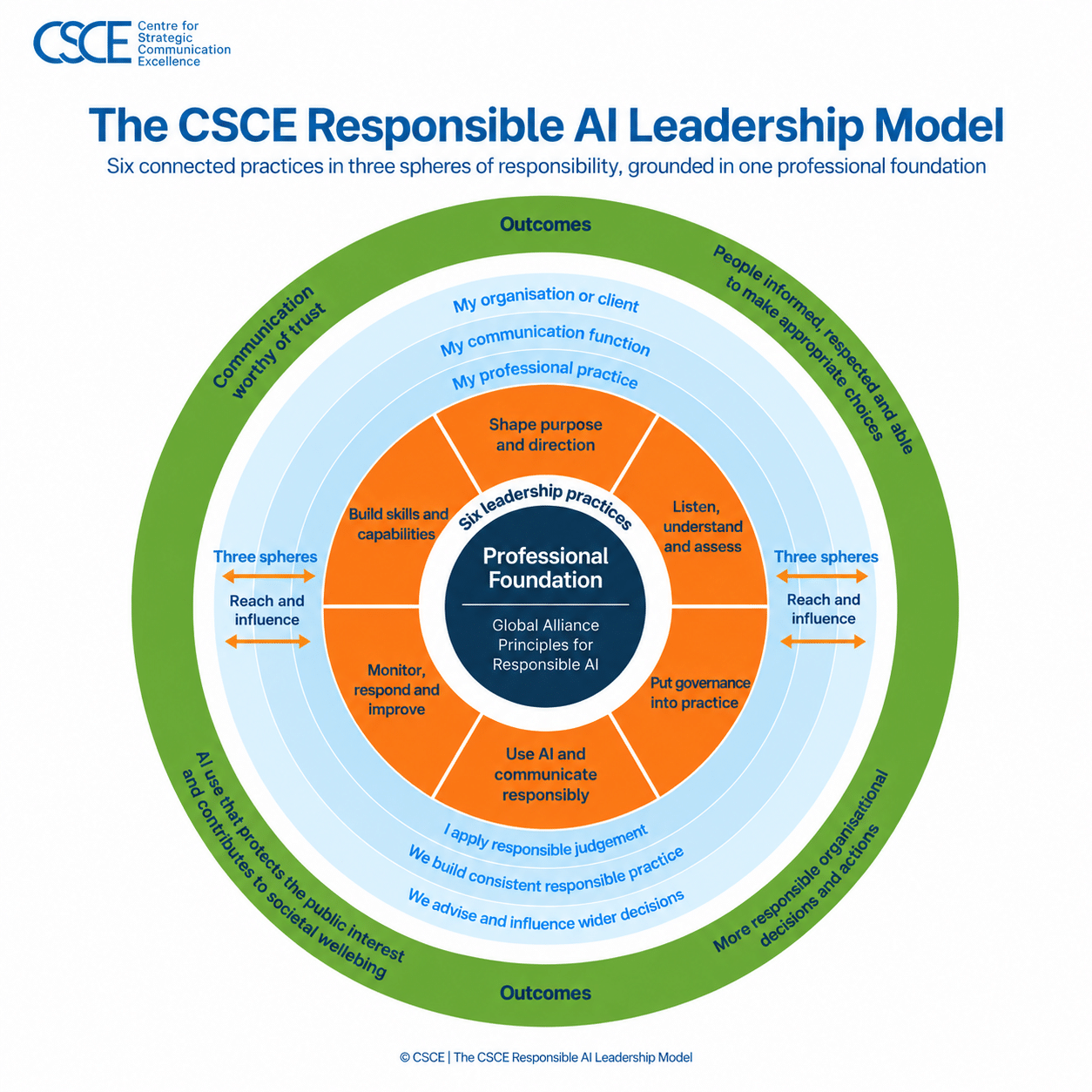
The CSCE Responsible AI Leadership Model — six leadership practices, three spheres of responsibility, one professional foundation.
- A professional foundation. Everything starts with the Global Alliance definition of responsible AI and its seven Principles. We didn’t invent a new ethical code — our profession already has one. The Framework shows you how to put it to work.
- Three spheres of responsibility. These show where communication professionals act: my professional practice, my communication function and my organisation or client. Your own daily use of AI is one sphere. How your team uses it is another. How your organisation deploys it — in customer service, HR, marketing, strategy — is the third, and often where our influence matters most.
- Six leadership practices. We shape purpose and direction. We listen, understand and assess. We put governance into practice. We use AI and communicate responsibly. We monitor, respond and improve. And we build skills and capabilities. Each practice applies in the same way across all three spheres.
- An outcomes ring. This names what it’s all for: communication worthy of trust, people who can make informed choices, more responsible organisational decisions, and AI use that protects the public interest.
What I like most about this structure is its consistency. You don’t need one playbook for your personal practice and another for your organisation-wide strategy. The same six practices scale up and down. A sole practitioner and a global head of communication can use the same language — and that shared language is what turns individual good intentions into a professional standard.
From model to action
A model on a page doesn’t change anything. So the Framework includes a practical pathway built around a handful of plain questions.
It begins with when. The Communication Involvement Check offers five questions to help you decide, early, whether communication needs a voice in an AI initiative. Early is the operative word. Join a project at launch and you manage the consequences. Join it at design and you shape them.
Then where and how. Locate the work in one or more of the three spheres, then clarify your role: do you lead, partner or influence? Be honest about it. You probably won’t lead your organisation’s AI procurement. You may well need to influence it.
Then what. Apply the six practices in proportion to the risk. A low-stakes internal draft doesn’t need the scrutiny of a public-facing AI assistant or a synthetic voice. Proportionality keeps the Framework usable rather than bureaucratic.
Finally, the question nobody likes but everyone needs: what if serious concerns remain? The Framework’s answer is simple. Raise it, record it, escalate it. Sometimes responsible leadership means being the person in the room who says, ‘Not yet.’
Putting it to work in your team
So where do you begin? Here’s what I’d suggest for any communication leader picking up the Framework.
Start with your own practice. Before you ask your team to change, look at how you use AI yourself. Where does it shape your thinking? Where do you check its work, and where don’t you? Credibility starts here. For instance, I have used AI to help me pull and sort the information I needed to structure this article. I gave it what I needed and where; it then gave me a draft, which I edited and changed. It then did a final spell check and made suggested grammar changes that I did or did not accept.
Map where AI already touches your communication. Most leaders underestimate this. Ask your team which tools they use, for what, and with what information. An hour of honest conversation will teach you more than a month of policy drafting.
Run the Involvement Check on one live initiative. Pick something real — a chatbot, an analytics tool, an AI-assisted content generator — and work through the five questions with the project owner. Nothing shows colleagues faster what communication brings to AI decisions.
Agree how you’ll disclose. Transparency is where we win or lose trust. At the CSCE, we tested this practice on ourselves first, building our own AI Disclosure Guide around a single question: would knowing change how someone understands or trusts what’s in front of them? If yes, we say so. Your test may differ. What matters is that you have one, and that your team applies it consistently. As the landscape changes, you adapt; that’s why we call disclosure a guide, not a policy. Context is everything in our world of communication.
Invest in capability. Skills sit among the six practices for a reason. Responsible use depends on people who understand what AI can and can’t do — and who feel confident enough to question it. Don’t always leave capability in the hands of the individual, as people seldom find the time to carve out professional development. We need to support or advocate for learning and experimenting time within our organisations.
The profession’s moment
I’ve worked in this profession for a long time, and I’ve watched plenty of moments when communication professionals could have stepped forward and didn’t. I must admit I date myself when I say the introduction of personal computing. Then the world wide web. Then social media. Each time, we eventually arrived — but often after others had set the terms.
AI differs in one important way. It works inside the very thing we’re responsible for. Communication is no longer just something AI touches. It’s something AI does. That makes responsible AI our business in the most direct sense possible.
The Reimagining Tomorrow data tells us the profession is stepping forward. Governance is growing. Confidence is rising. Now we need to turn that momentum into leadership that’s practical, proportionate and visible — in our own work, in our teams and in the organisations we serve.
The CSCE Responsible AI Leadership Framework for Communication gives us a shared way to do that. CSCE professional members can download the full Framework from the CSCE website today. Use it. Test it with your team. Tell us what you learn — this is a first edition, and the profession will shape the next one.
Because the question was never really which tools we use. It’s who we choose to be when we use them.
Adrian Cropley OAM, FRSA, FCSCE, FIABC, SCMP, is Co-Founder of the Centre for Strategic Communication Excellence.
In the spirit of transparency: this article was developed in collaboration with AI, which I use to help shape and refine my writing. The ideas, judgement, and final voice are mine.