

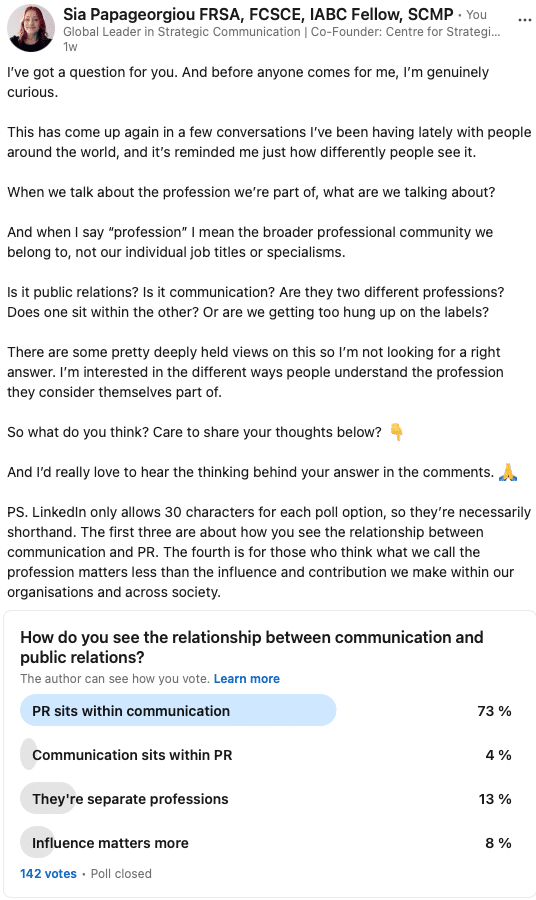
How do you see the relationship between communication and public relations? I asked that question on LinkedIn after hearing very different answers in conversations with colleagues. People who seemed to agree about the importance of relationships, trust and good advice could still draw the boundaries of our work in opposite ways. I wanted to know how others described it.
LinkedIn limited this poll to four answer choices, so I had to compress a rather large question. The choices were that PR sits within communication; communication sits within PR; they are separate professions; or influence matters more than the label.
The poll closed with 142 votes and 26 comments, including replies. LinkedIn displayed 73% for PR within communication, 4% for communication within PR, 13% for separate professions and 8% for influence matters more. This was a small, self-selected group, and no one should read it as a measure of what the profession as a whole thinks. Still, the clear lead for one answer sits alongside a discussion in which people meant different things by the same words.
Some of the votes genuinely surprised me. People I’ve known for years didn’t always answer as I’d expected. It made me wonder how often we assume we mean the same thing by these terms without ever asking.
What Do We Hear When Someone Says PR?
For some people, PR describes a broad profession concerned with an organisation’s relationships with its publics. The Public Relations Society of America defines it in terms of strategic communication and mutually beneficial relationships. Its description includes advising management and working across internal, executive, corporate and crisis communication. The Chartered Institute of Public Relations also counts employees and managers among an organisation’s publics. Here, public doesn’t mean external.
Trevor Young made that case in the comments of my LinkedIn post. He sees PR as the overarching discipline and communication as a central function within it. Relationships, reputation and trust are at its heart. He also observed that communications may sound more palatable in a boardroom, where PR can carry less helpful associations. A term with a wide professional definition can have a much narrower meaning in everyday use.
I tend to see communication as the broader field, with PR as one of its disciplines. That feels true to the range of internal and external work many of us do. IABC’s Global Standard, for example, describes communication professionals working with employees, customers, partners, shareholders and communities, and advising, listening and evaluating as well as producing messages. Yet Trevor’s account describes much of the relationship work that I, too, believe belongs at the centre of communication. Our disagreement about the umbrella may conceal a great deal of agreement about the work.
Several commenters also used communication as the broad term, although they differed on what belonged beneath it. Where does marketing fit? What about social media or sales? The poll couldn’t accommodate those possibilities. Nor could it capture someone who thinks PR is a specialism in their organisation but uses public relations more broadly in a professional association. Our choices of language depend partly on the setting in which we work.
The poll options themselves left room for overlap. The first three asked how two terms relate to one another; the fourth asked what matters most in practice. Someone could believe PR sits within communication and vote for influence. Someone who chose separate professions might still agree with others about much of the work. The percentages show how these 142 people answered the options I gave them. The comments reveal some of what the four choices could not.
A Common Body of Work
The variety is not confined to a LinkedIn thread. A nine-country project for the Global Alliance for Public Relations and Communication Management set out to identify capabilities shared across the field. Its researchers noted that public relations covers different functions in different countries, while organisational communication, corporate communication and strategic communication are sometimes used almost interchangeably. They found a widely shared set of capabilities, with some significant differences between countries in terminology and in views of the field’s social role.
The framework describes what people can do without choosing an umbrella for them. It suggests there is common ground even where language differs. A definition that makes sense in one country may not fit as well in another.
There is research on what happens when people outside the function try to make sense of it, too. In a 2017 Swedish study involving 6,486 responses across 11 organisations, managers and colleagues saw communication as strategically important, yet a majority of respondents did not understand the core role of communication professionals. The study did not establish that job titles or disagreement over PR caused that uncertainty. It did identify a gap between recognising the importance of communication and understanding what its practitioners contribute.
A more recent study by Charlotte Simonsson, Mats Heide and Rickard Andersson drew on interviews with 81 senior managers and communication practitioners in four organisations. The researchers found that communication professionals themselves often described their work in relatively narrow, production-focused terms. In group discussions with colleagues, they were better able to explain its strategic role. This is a useful challenge. Even if we settled on one name tomorrow, would we be any clearer when asked what we do before we write a message?
What Colleagues Think We Do
The poll’s fourth option, about influence, struck a chord in the comments. Amanda Blesing asked whether we give people outside the field enough clarity and credibility to understand our contribution. Helen Taylor added that influence without trust may be short-lived. Anthea Cudworth pointed to the absence of a single global definition or body of knowledge. Together, their comments made me think about how we explain our expertise and what makes others confident enough to use it.
Consider a major organisational change. A leader might hear communication and expect a team to prepare an announcement once the decision is made. Another might hear PR and think first of journalists and external reputation. A practitioner using either term could expect to advise early, listen to employees and other affected groups, test assumptions and help leaders respond. Neither title inevitably carries those assumptions. But the gap between what the practitioner means and what a colleague hears is easy to imagine.
It can show up in a job description or a reporting line. It can determine who’s invited into a discussion while options are still open. A team may be judged on the volume of content it produces when its most valuable contribution was identifying a concern early enough to change a decision. The title acquires meaning from the brief the team is given and the work colleagues see it do.
A strong majority for one umbrella still doesn’t close the discussion. It leaves questions about the edges of the umbrella, what the profession expects of its members and how we explain that to the people who work with us. It also leaves room for a colleague who uses a different name but takes responsibility for the same relationships, ethics and advice.
I don’t expect this poll to settle the terminology. But it’s made me more conscious of what I assume when I introduce myself and my work. If I say communication, does the person across the table hear an adviser or a producer of content? If someone says public relations, do I assume their publics are outside the organisation? We can ask each other what we mean before we argue about where to draw the line.
We need to be clearer about what people can expect from us. We should be able to explain which relationships we help an organisation understand, when we should be involved, what standards guide our advice and how we know whether we’ve helped.
Perhaps the most revealing answer would come from a colleague outside the function. What do they expect of us, and when would they seek our advice? If they see only a post, a media release or an announcement, our discussion about professional identity has practical consequences. The poll showed where 142 people placed the umbrella. It could not tell us whether anyone beyond it knows what’s underneath.