

This series looks at three realities of the AI journey ahead and why it’s critical that communication and change professionals are part of the conversation. Today, we’re posing a disturbing question. If we’re struggling with the pace of change today, how the hell will we cope with tomorrow?
Oh no. It’s the training trainwreck!
Welcome to our third reality about why comms and change need to be part of the AI conversation. It looks at what happens when you don’t put people first (hint… it’s ugly). If you missed them, click here for the first two realities about the magnitude and pace of change we’ve got waiting for us.
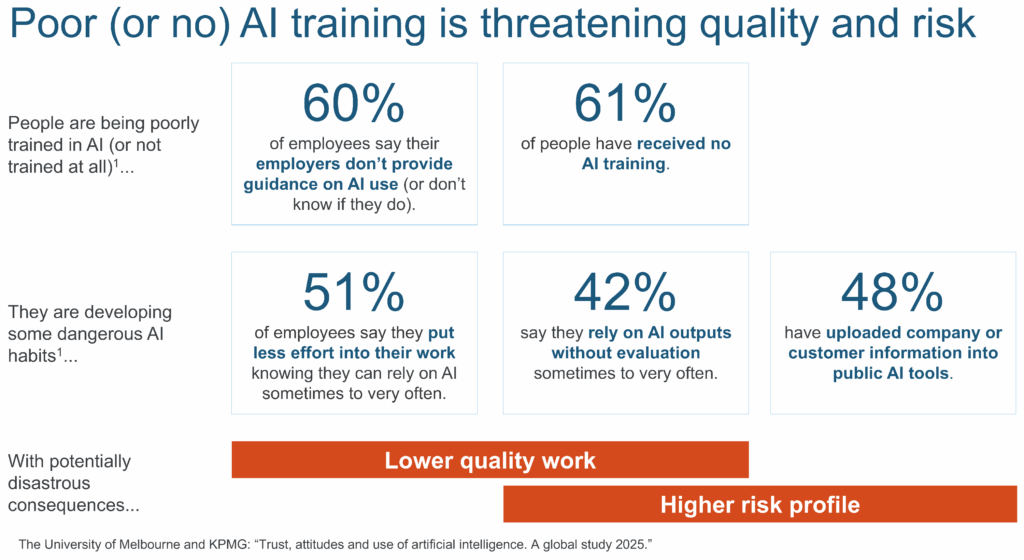
One of the most powerful AI studies to emerge this year was a survey of almost 50,000 people across 47 countries by KPMG and the University of Melbourne. It asked people about their AI usage, habits and attitudes and it’s choc-full of useful insights. Yes, it’s a few months old now but it’s seriously worth a read.
Reality 3: The training trainwreck
To me, the highlight (or, more correctly, lowlight) of the report concerns AI training.
First up, the report suggests that a high proportion of AI users have received either no or poor AI training. Okay, no surprises there. Plenty of reports have said the same.
What makes this research different is that it digs deeper. It asks people how they actually use AI.
And the responses? They’d make Freddy Krueger cower in a corner.
Large numbers of people admit they’re putting less effort into their work because of AI. They’re accepting AI outputs without validating them. And, just to keep the cybersecurity team awake at night, almost half say they’ve uploaded company or customer data into public AI tools.
Honestly… what the? Now you know why we’re calling this a trainwreck.
AI anxiety: another potential side effect
If that wasn’t enough, here’s another kick in the guts.
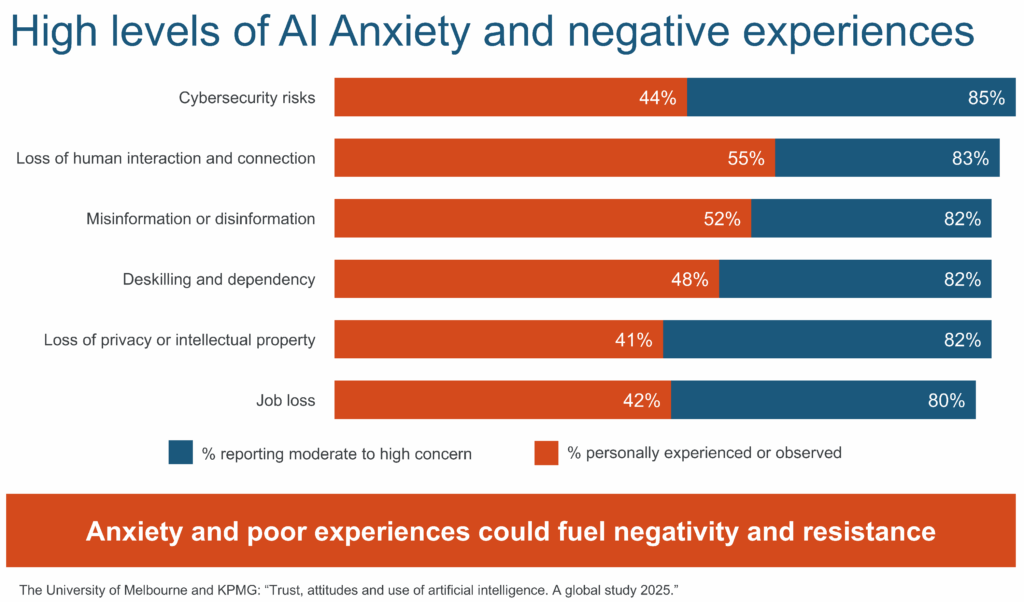
The same KPMG / University of Melbourne study found that people have a long list of concerns about AI. They include job loss, cybersecurity, loss of human connection and a growing dependence on machines.
What’s worse is that many are saying they’ve actually experienced these issues.
Wow. For a technology that’s supposed to help us, AI seems to be creating a surprising amount of stress.
What a shocker!
Clearly, not putting people first isn’t working. It’s driving:
- Lower quality work
- A higher organisational risk profile
- A cocktail of anxieties that chip away at our trust and confidence.
This is exactly the opposite of what we want from AI. And exactly the scenario comms and change teams are built to prevent.
And, on a related note, ensure leaders are aligned, transparent and communicating effectively. This is critical to:
A ray of hope
Thankfully, it looks like we’re now seeing the conversation shift.
More leaders are advocating a human-centric AI approach. Where training, responsible AI literacy and change management are foundational to AI ROI.
This view was supported by CapTech Consulting’s recent 2025 Executive Research:
“Without a people-first approach, even the most promising AI investments risk falling flat. Organizations frequently underestimate the importance of trust, training, and change management in successful AI adoption. There’s a common assumption that implementation alone will drive usage. But without engagement, adoption stalls.”
And this from Deloitte’s Turning AI into ROI:
“AI ROI Leaders are more likely to view AI fluency as a non-negotiable core competency. Among AI ROI Leaders, 40 per cent mandate AI training. Leading organisations are moving beyond voluntary education to embed AI understanding as a fundamental skill across their workforce.”
What this means for comms and change professionals
If you’re in comms or change, this moment is quietly redefining your role. It could also significantly expand your influence (if you grab the opportunity).
The key is to remember that AI isn’t just a tech adoption program. It’s a people shift… a massive transformation of the way people work.
In a transformation like this, communication, clarity, confidence, capability and care are the levers that matter most. This is where comms and change professionals become indispensable.
So, what does this mean in practice?
1. Stand up for people and human centricity
At every turn and in every conversation, we need to be representing the interests and needs of people – employees, customers and everyone else. It’s critical that people don’t get lost in the race to AI supremacy.
If they do, it may end up a race to the bottom.
2. Train. Engage. Support. Embed. Transform.
Your job is to demystify the technology, show what “good” looks like, and build a sense of psychological safety around experimentation. When confidence rises, anxiety falls and responsible adoption increases.
3. Co-own AI literacy
Training alone isn’t enough. People need context. They need stories, examples, scenarios, nudges, mindsets and habits. All the things comms and change excel at.
This is how AI stops being a novelty and becomes a skill.
4. Help leaders lead the new world of work
Many leaders are still trying to figure out what they should say, do and model.
With the right support, they can be powerful role models for responsible, high-quality AI transformation. Helping them do that is a critical comms and change deliverable.
5. Help to ensure that AI actually delivers ROI
This is your moment. Don’t just communicate about AI. Start driving ROI by shaping how the whole organisation uses it.
6. Make sure your responsible AI skills match your aspirations
To state the obvious, you can’t lead the AI conversation if you haven’t mastered AI yourself. So, get started today.
Bottom line
If AI is the engine, people are the drivers. And no smart organisation hands out a powerful new machine without showing people how to turn the steering wheel.
This is why comms and change matter. Not as support functions, but as the disciplines that help organisations turn hype into hope… and hope into reality.
Join Our Final Communicating AI Forum of 2025!
Exploring Agentic AI

Our AI forum is a relaxed, judgment-free space to ask questions, share experiences, and explore how AI is shaping our profession — whether you’re just starting out or already experimenting.
This final session for 2025 takes place on: 18 December, 6:00 PM EST / 19 December, 10:00 AM AEDT
or 19 December, 10:00 AM CET / 19 December, 11:00 AM CAT