

I’ve conducted thousands of interviews across nearly two decades, and one rejection pattern stands out above all others: experienced professionals being ruled out with vague labels like ‘too senior,’ ‘too broad,’ or ‘not quite the right fit.’
These aren’t thoughtful assessments. They’re red flags that reveal a deeper problem: hiring managers don’t know what they’re actually looking for, and they haven’t been trained to figure it out.
What 'Too Senior' Actually Means
When a hiring manager says someone is ‘too senior,’ they’re rarely making a skills-based judgment. What they’re actually signalling is discomfort. Discomfort with experience they don’t know how to assess, with salary expectations they haven’t validated, or with seniority that challenges their own.
In my experience, this label most often appears when:
- The role was poorly defined to begin with. If you can't articulate what success looks like in 6, 12, and 18 months, you can't assess whether someone is overqualified or under qualified. You're just guessing.
- The hiring manager mistakes confidence and strategic thinking for inflexibility. Someone who can explain why they made decisions, and what they learned when things went wrong, isn't difficult. They're exactly what senior roles require.
- Age bias is lurking beneath the surface. Experienced professionals are seen as expensive, resistant to change, or 'not hungry enough.' None of which have any predictive value for performance.
Why Breadth Gets Misread as a Weakness
Candidates with breadth across internal and external communication, leadership advisory, or change management are dismissed as ‘too broad’ or ‘not specialist enough.’ This is backwards.
Breadth isn’t dilution. For communication professionals especially, it’s often the foundation of strategic capability. Someone who has worked across stakeholder engagement, internal narrative, media strategy, and crisis response isn’t scattered. They understand how these functions interact.
The problem is that many hiring managers evaluate communication roles the same way they’d evaluate an engineering or finance hire: looking for narrow, repeatable technical expertise. But communication work, particularly at senior levels, is fundamentally different. It requires judgment over process, political intelligence, and strategic pattern recognition. Breadth gives you this.
If your hiring process is optimised for narrow specialists, you’ll keep hiring people who can execute tasks but can’t solve the underlying issues your organisation actually faces.
Where the System Breaks Down
The foundational issue: most organisations treat hiring as a process problem. They add more steps, more interviews, more approvals, thinking that volume and structure will lead to better decisions. It doesn’t.

The real issue is that managers make hiring decisions that shape teams and culture, but they’ve never been trained to do it well. The patterns I see most often:
- No clear outcomes defined before hiring starts. If you don't know what the role needs to achieve in 6, 12, and 18 months, how can you possibly assess who's capable of delivering it?
- Interview loops that test for likability, not capability. Unstructured conversations dominated by the highest-paid person's opinion rather than evidence-based evaluation.
- Reliance on gut feel over structured assessment. Intuition has a place, but only after you've gathered real signal through competency-based evaluation.
What Needs to Change in 2026
- Define success before you define the candidate. Start with outcomes: what must this person achieve in 6, 12, 18 months? Then work backwards to the competencies required.
- Stop conflating confidence with arrogance. A candidate who can articulate their thinking and challenge assumptions is demonstrating exactly the kind of judgment senior roles require.
- Assess for competence, not comfort. Structured, evidence-based interviews reveal capability. Casual conversations reveal who you'd like to have lunch with. The two are not the same.
- Make your experience legible. Breadth is an asset, but only if you can explain how it connects. Show how diverse experience gives you pattern recognition others lack.
- Lead with outcomes, not tenure. Twenty years of experience means nothing if you can't articulate what you delivered. Be specific.
- Anticipate the 'too senior' concern directly. If you sense it coming, acknowledge it. Own the narrative before they misread it.
Hiring isn’t an administrative task. It’s a strategic capability that shapes everything: team performance, culture, execution, trust. Yet most organisations treat it as something managers should ‘just know how to do,’ with no training, no frameworks, and no accountability.
The gap between what organisations say they need and what they actually hire is vast. It won’t close through better job postings or more interview rounds. It will close when hiring managers learn to define success clearly, assess capability rigorously, and recognise that experience and breadth aren’t liabilities.
Both sides need to change. The question for 2026 is: who’s willing to move first?
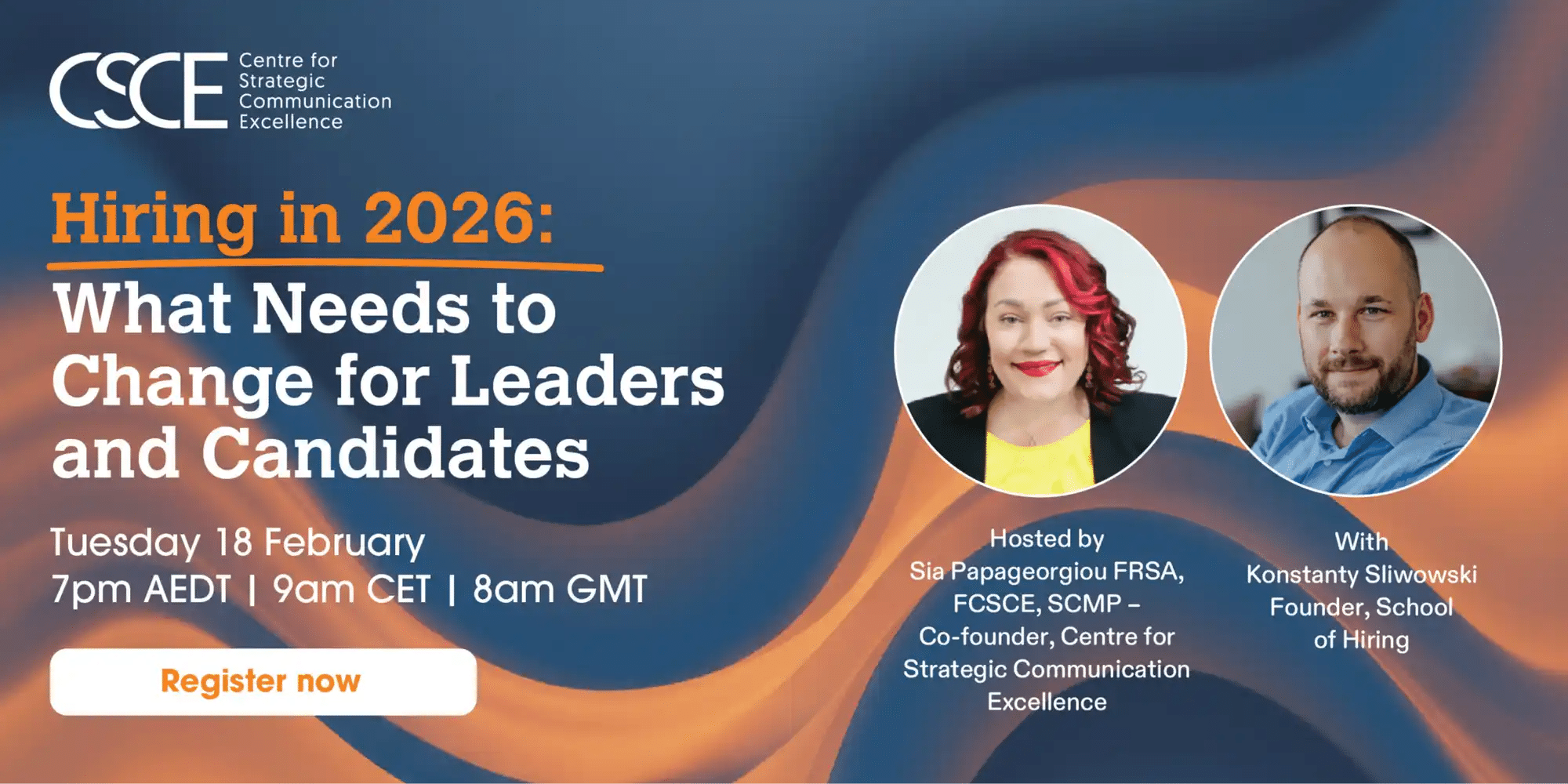
Tuesday 18 February
7:00 PM AEDT | 9:00 AM CET | 8:00 AM GMT
Hiring processes are still sidelining some of the most capable communication professionals — often for vague, unhelpful reasons like “too senior,” “too broad,” or “not quite the right fit.” Beneath those labels sit deeper issues: discomfort with experience, misunderstanding of judgement-based roles and a growing but rarely acknowledged problem of ageism.
This webinar looks ahead to hiring in 2026 and asks some necessary questions about how communication capability is assessed, why experienced professionals are so often overlooked, and what needs to change if organisations genuinely want stronger leadership, trust and influence.
Hiring in 2026
What Needs to Change for Leaders and Candidates